Critical game modification
Anti-Monopoly: Breaking the System
A Twine game that reframes Monopoly as an interactive story about debt, ownership, inequality, and structural pressure.
Project file Anti-Monopoly
Twine game · economic critique · branching choice · interface feedback
Critical game modification
A Twine game that reframes Monopoly as an interactive story about debt, ownership, inequality, and structural pressure.
My Role + Duration
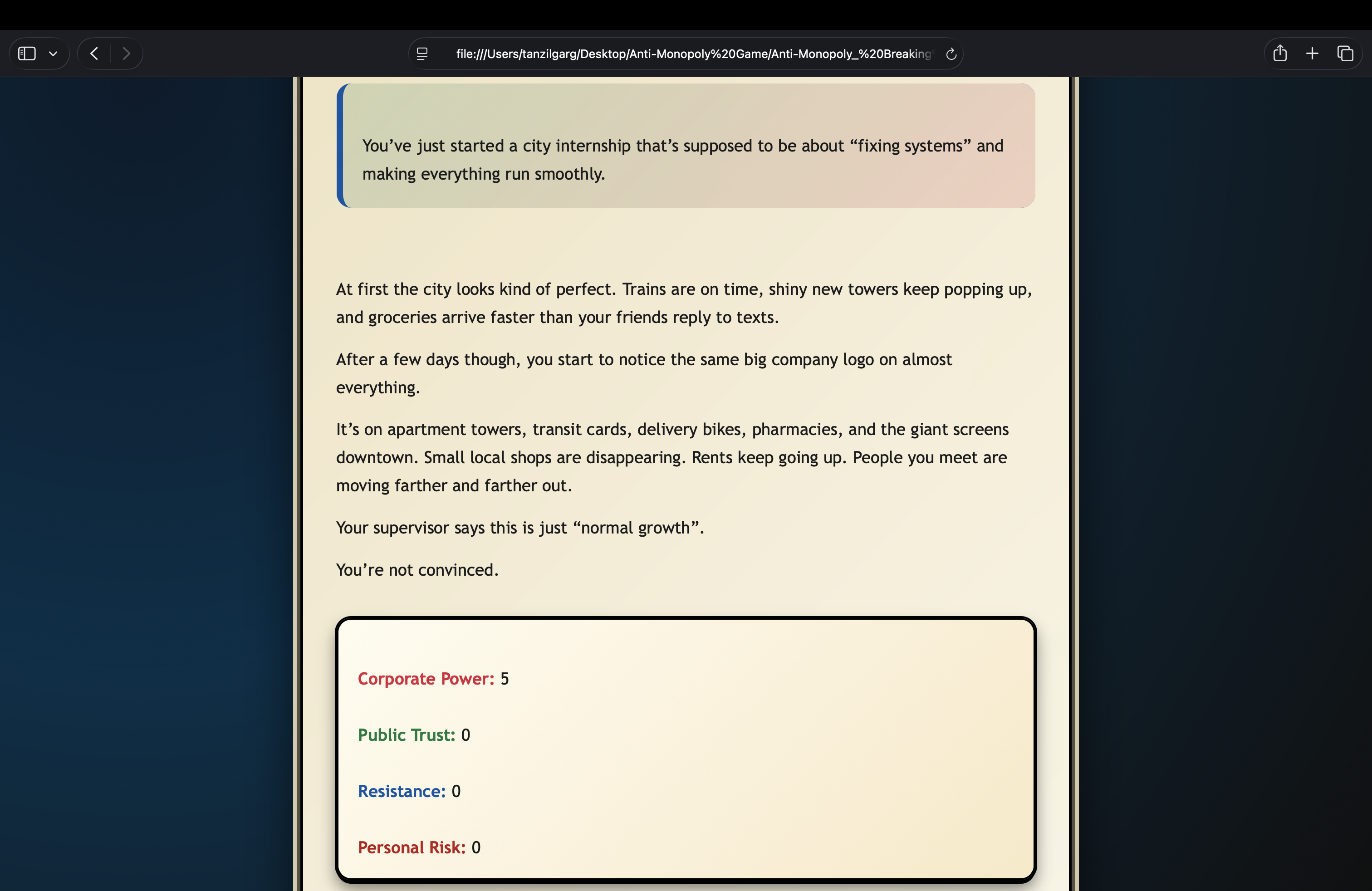
Reframed Monopoly's economic loop as a branching narrative about ownership, debt, public trust, and resistance.
Wrote passages, choices, and consequence text so the critique could be experienced through interaction.
Structured links, feedback moments, and interface hierarchy to help players understand cause and effect.
Completed during the 2026 term as a course project with a future revision plan for clearer system feedback.
Project Overview
This course project uses Twine to turn a familiar board-game economy into a branching critical narrative. Instead of rewarding accumulation as a neutral objective, the game asks players to experience how ownership, rent, public pressure, and resistance shape outcomes.
The product is a playable story system with passages, choices, consequences, and interface styling that supports the critical argument.
Problem + Goals
Monopoly's familiar loop can make extraction, scarcity, and bankruptcy feel ordinary. The design challenge was to make those assumptions visible through interaction.
Make each player choice readable and consequential.
Show that individual agency is constrained by a larger system.
Use branching structure to support critique rather than only retell the original game.
Research Plan
The review focused on passage completion, clarity of choices, and whether players could follow cause and effect across a short play session.
Qualitative feedback centered on the emotional shift from familiar game reference to discomfort, resistance, and critique.
Findings
"I recognize the Monopoly structure, but this version makes it feel less harmless."
"The choices feel like choices, but the system still pushes back."
"I want to know how my previous decision changed the next scene."
The strongest direction was to make systemic pressure visible after each choice, because players need to see how individual agency is shaped by the larger rule structure.
Personas + Empathy Map
Persona 01
Recognizes Monopoly and wants the modification to reveal what the original system normalizes.
Persona 02
Needs clear links, passage hierarchy, and feedback to understand how choices shape the story.
What did my choice change?
This feels familiar, but the outcome is uncomfortable.
Clicks passages and looks for consequence cues.
Curious, uneasy, and more engaged when the system responds visibly.
Insights & Opportunities
The Monopoly reference helps users enter the experience quickly before the critique changes their interpretation.
Players understand the critique more clearly when consequences appear immediately after decisions.
The game should not make every choice feel equally powerful because the topic is structural pressure.
Proposed Solutions
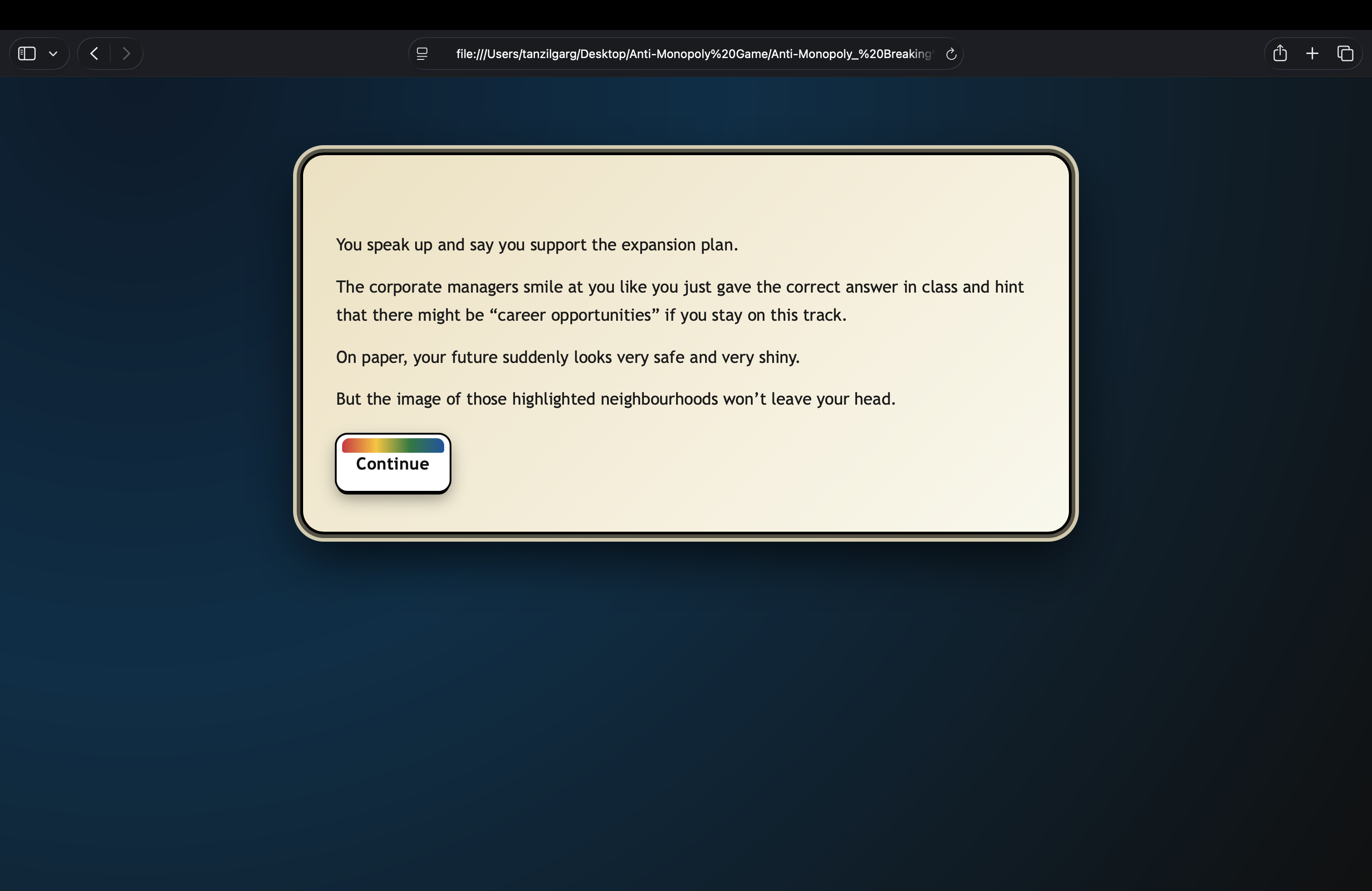
Pair each decision with immediate narrative feedback.
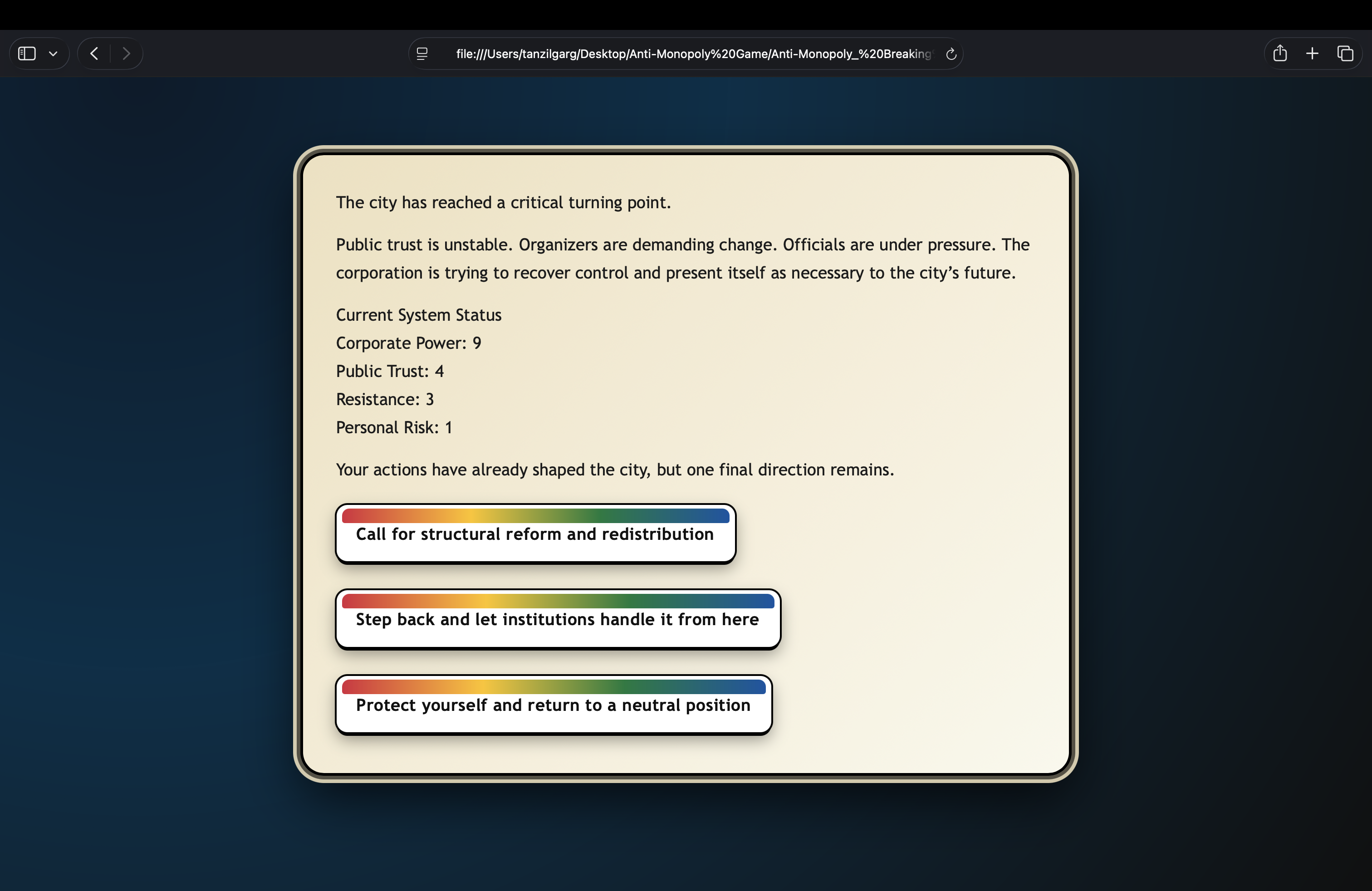
Show trust, resistance, or pressure changes more clearly in future versions.
Use ending summaries to explain how player decisions interacted with the larger system.
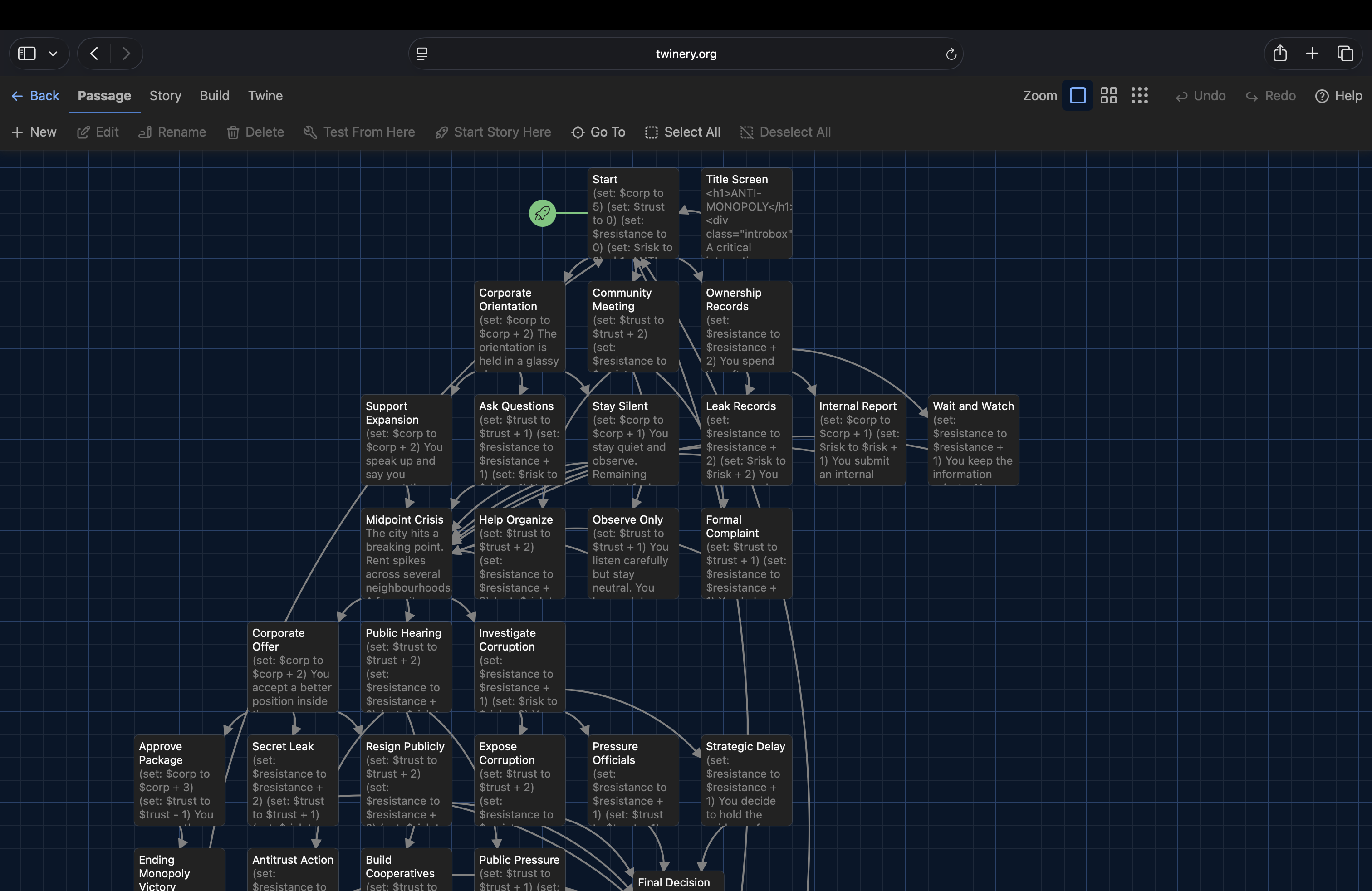
Document the branching map so reviewers can inspect the logic.
Enter modified economy -> Choose response -> Receive consequence -> Build pressure or trust -> Reach critical ending
Reflection + Lessons Learned
This project taught me that a game can operate as an argument when interaction, feedback, and consequence are aligned.
The main lesson was that critical design needs both clarity and friction. Players should understand what they can do while still feeling the limits of the system being examined.
In a future version, I would make variables more visible and add playtest notes that compare how different players interpret the endings.